
Soap Opera Sequence Template (From Russell Brunson Himself)
A soap opera sequence is all about two things:
- Telling your unique story.
- Using that story to make more sales (wherever you tell it).
Contrary to popular belief, this powerful sequence can be used almost anywhere.
Just think about all of the platforms where you can tell your story:
- Email.
- YouTube.
- Facebook.
- Instagram.
- And any other social media platform.
That’s what makes this strategy so powerful when it comes to online marketing:
You can use the soap opera sequence anywhere that you can tell a story.
But for the sake of this post, we will exclusively be using it when sending emails.
- But what is it exactly?
- And what are some examples?
Allow me to help you with answering those two questions.
What Is The Soap Opera Sequence & How Can You Use It?
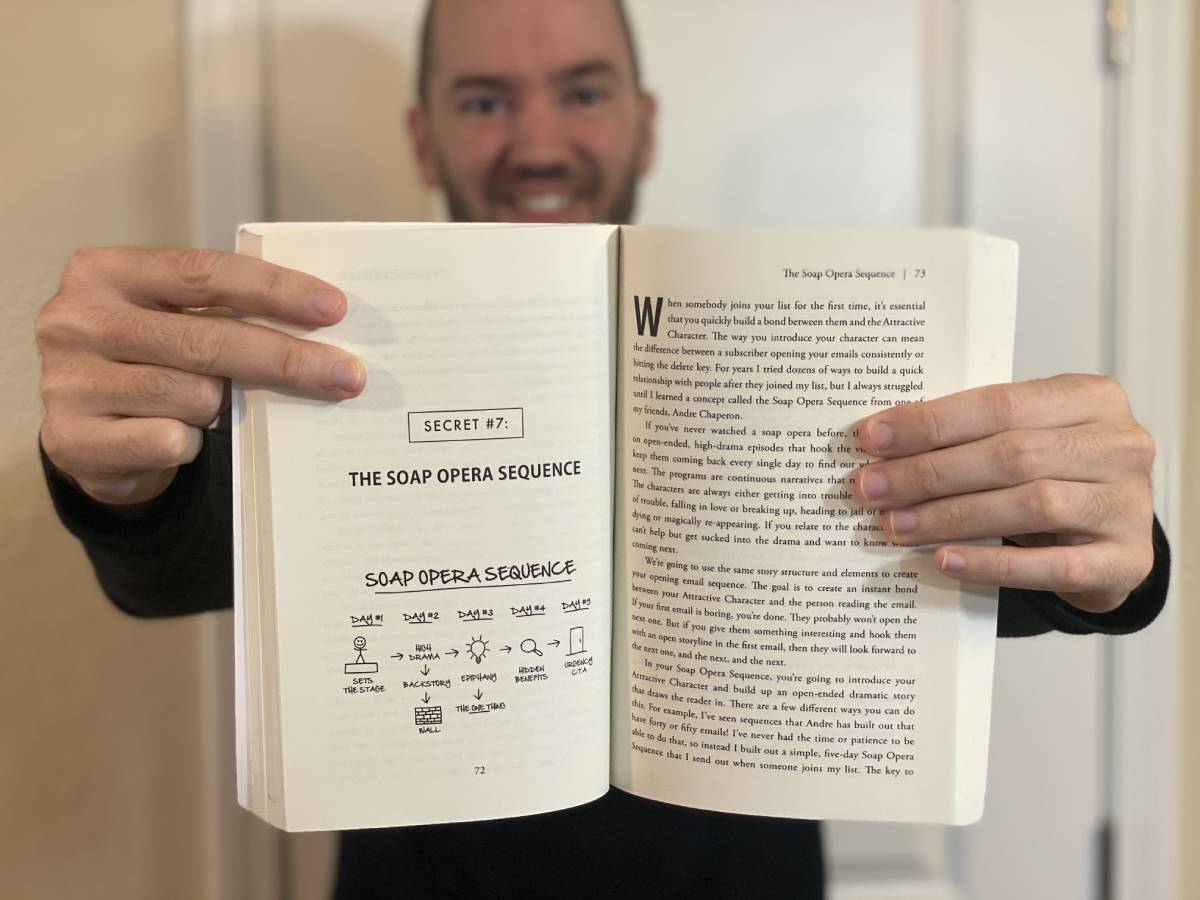
So most people think that Russell Brunson adopted the SOS (soap opera sequence).
He actually didn’t.
As stated in Dotcom Secrets, he learned the sequence from his friend, Andre Chaperon.
More Russell Quotes: Read them here.
Anywho, have you ever watched a high-drama type of show or even a soap opera?
- Where they end each episode with a cliffhanger.
- A cliffhanger that’s so popular that it hooks you into watching next week.
There’s always some sort of drama, trouble, or romance.
And with that, you find yourself asking similar questions like:
How in the world is this person ever going to dig themselves out of this hole?
That’s the power of using this marketing sequence, and when it comes to email marketing?
A soap opera sequence is a series of 5 emails that are designed to hook your readers into reading your next email, allowing you to convert at a much higher rate.
Think of a Soap Opera Sequence as this:
- Email #1 hooks the reader into reading email #2.
- Email #2 hooks the reader into reading email #3.
- Email #3 hooks the reader into reading email #4.
- Email #4 hooks the reader into reading email #5.
Aside from hooking your readers, you are also:
- Generating rapport.
- Relating to your audience.
- Becoming an attractive character.
This, of course, can certainly help you convert sales at a much higher rate.
Combine this sequence with the power of a properly setup value ladder?
And you’ve got a recipe to not only convert more sales but also make more high-ticket sales.
The Value Ladder: Here’s how it works.
Let’s move onto the next section now.
Soap Opera Sequence Template (5 Powerful Emails For Increasing Your Sales)
So there are only going to be five emails total in this sequence.
Don’t feel like everything is said and done after that though, as you can always:
- Add a few more emails to the sequence.
- Keep repeating the process with many more offers.
Just make sure that you keep capturing leads, which you can do with the Dream 100.
Dream 100: Read how it works here.
Now onto the very first email.
Email #1: Set The Stage
This is going to be one of the most basic emails that you write.
It’s called set the stage because you are setting the expectations for your subscribers.
- What will they see in the following emails?
- How often are you going to be emailing them?
As Russell Brunson recommends, one email every day for this sequence works well.
Aside from the basics of setting the stage, be sure to end this email with a cliffhanger.
Here is an example:
P.S. The email that I’ll be sending you tomorrow is called My $40,000 Failure. Make sure that you open it up as soon as you get it.
The first email is easy, just make sure that you properly set the stage for your subscribers.
Email #2: Open With High Drama
And then, at the snap of my fingers, everything was gone forever.
A tremendous amount of hard work, time, effort, and over $40,000.
All gone.
And to make matters worse, I was the one who had to make this difficult decision.
Those four lines above was an example of opening with some form of high drama.
Painful Note: It’s actually a true story of when I had a solo ads business (barf).
Daegan Smith recommended that you should always start a story with high drama.
After all, this is what allows you to hook your audience into the rest of your fine story.
Here are the steps for email #2:
- Open with the highest-drama-aspect of your story.
- Rewind a little bit and talk to them about the back story.
- In the end, talk about how you hit a wall and then found the solution.
Here are some questions that you can consider answering in this email:
- How did you get yourself into such a bad spot?
- What was your life like and how did it feel (like crap, most likely)?
Don’t be afraid to write a slightly longer email.
Not as long as this blog post, but enough to keep your subscribers interested to read more.
Lastly, you are going to mention how you hit the biggest brick wall in the world…
But you found a solution.
Don’t tell them the solution, just hint at it with a cliffhanger going into the next email.
Email #3: Epiphany
An epiphany can be defined as a sudden, intuitive perception or insight about something.
In other words, it’s going to be the turning point where your problem was finally solved.
- Note #1: This is where we finally get to promote the offer that you have.
- Note #2: You can even promote an offer that you don’t own as an affiliate.
Here are a couple of scripts that I modeled from the Russell’s Dotcom Secrets book:
- My epiphany was that I needed to generate traffic, and that’s when I learned XYZ.
- I needed to get support in order to get to the next level, that’s when I found XYZ.
- I couldn’t convert all of my traffic, and it’s a good thing I stumbled upon XYZ.
Make sure that you fill in the XYZ part with whatever solution that you came across.
Also, make sure that you add these two aspects to this email as well:
- A link to the solution with a call to action.
- Yet another cliffhanger (or open-loop) for the next day’s email.
Let’s talk a little bit about the next email that you’ll be sending now.
Email #4: Hidden Benefits
So what else are your readers going to receive by following the product that you found?
This email is all about providing hidden benefits.
They are called this simply because these benefits aren’t all too obvious to your readers.
Here are a few examples for you:
- Sure, you can make more money, but you’ll also have much more freedom.
- Sure, you’ll do less work, but you won’t need to be chained to your computer.
- You’ll have a nice passive income stream, but you won’t have to work with clients.
Get the idea?
For every benefit that the product offer, think of many more benefits that it can provide.
So here are the main sections that you’ll want to include in this section:
- A story (as always).
- More hidden benefits of the product.
- A link along with a call to action (or even a discount).
This is one of the emails where you won’t need to have an open-loop at the end.
Let’s move onto the last email now.
Email #5: Urgency And CTA
This is going to the last email of the sequence.
The goal is to provide your subscribers with a reason to take action as soon as possible.
You’re also going to be kicking up the heat on your call to action.
Here are a few examples that came straight from the Dotcom Secrets book again:
- I’m pulling the video offline.
- The perfect webinar starts tomorrow.
- There are only ten seats left at the event.
- I only ordered one thousand books, and most of them are gone.
Beneficial Note #1: Make sure that if you use scarcity, you actually do what you say.
Fake scarcity will backfire on you and have you quickly losing your credibility.
Beneficial Note #2: You can certainly use this sequence to send traffic to a webinar.
And if you plan on running a webinar yourself?
I highly recommend that you read the related post that I linked down below.
Highly Related: All about the Perfect Webinar template.
This email doesn’t need to be all that long (which means less writing for you).
So that’s the main idea behind this special SOS.
Let’s move to the end of the post now.
Soap Opera Sequence Closing Summary
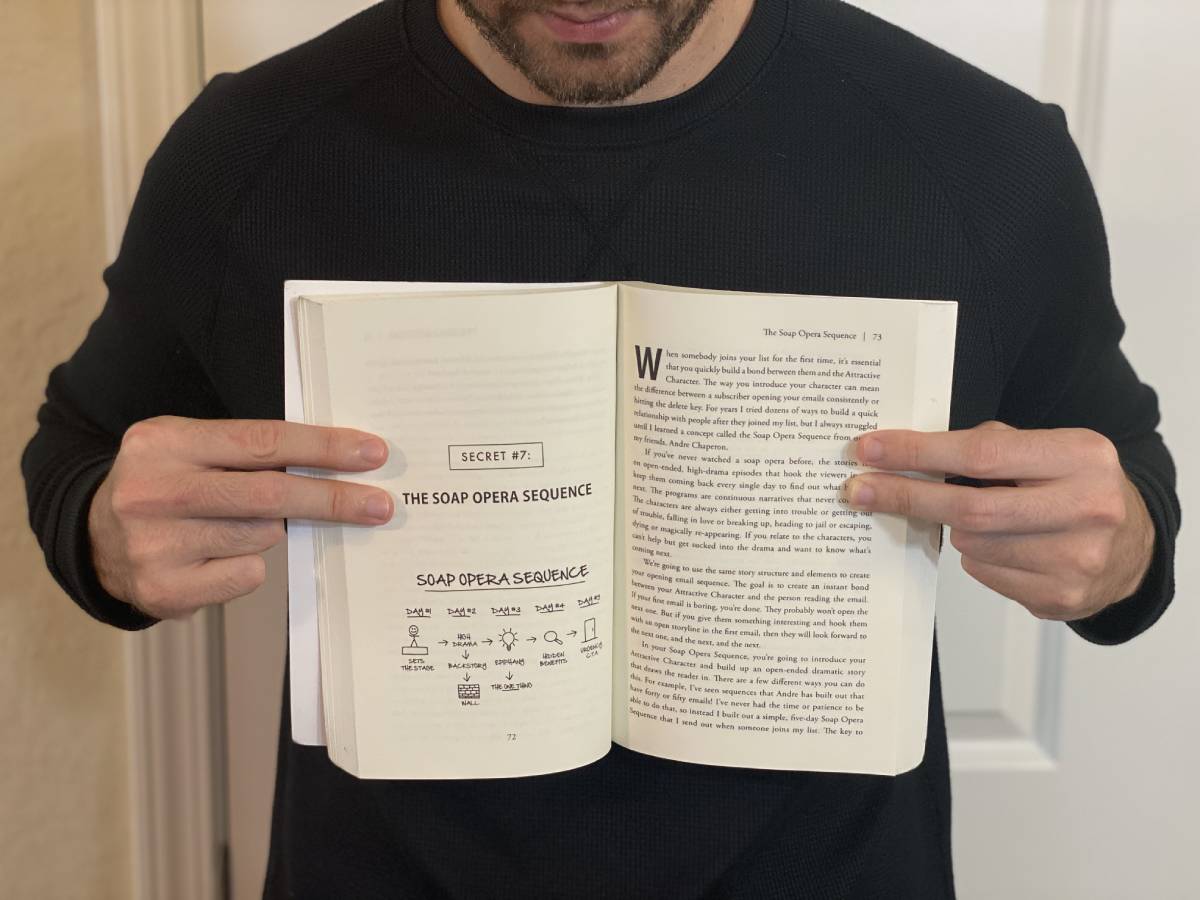
So what is the Soap Opera Sequence? Here is one more reminder for you:
A soap opera sequence is a series of 5 emails that are designed to hook your readers into reading your next email, allowing you to convert at a much higher rate.
I hope that this post helped you when it comes to writing high-converting emails.
About the Author James Canzanella
A former personal trainer who went from unemployment to online business success. He's been marketing since 2012 and (still) enjoys lifting weights, listening to rock music, and relentlessly quoting movie lines.
